Packaging Material Selection Guide: How to Choose Between Aluminum, Stainless Steel, Titanium, POM, & PEEK
Make data-driven performance and cost decisions for your packaging machinery, molds, and custom components. ZSCNC delivers integrated support from engineering consultation through rapid prototyping and mass production. Explore our stainless steel parts for robust packaging performance.
- Tailored material recommendations for food, pharma, and daily chemical packaging lines
- Systematic comparisons across corrosion resistance, wear, strength, weight, and cost metrics
- Practical CNC machining and short-run production feasibility insights from real-world project data
Who This Material Selection Guide Is Written For
This comprehensive guide is engineered specifically for mechanical engineers, project managers, procurement specialists, supply chain heads, and product innovators who face the challenge of evaluating multiple material options that all seem viable on paper.
Drawing from ZSCNC’s extensive field experience in industrial packaging lines and packaging automation systems, we break down complex material engineering data into clear, actionable steps. Our goal is to help you confidently narrow down your choices to the top 2–3 optimal candidates that balance mechanical performance with overall manufacturing costs.
Whether you are designing structural frameworks, high-speed moving mechanisms, or parts requiring strict regulatory compliance, this overview grounds your material selection in real-world application scenarios.
Food & Beverage
Pharmaceutical
Cosmetics & Care
Electronics Jig
Five Common Packaging Materials at a Glance
Use this overview to quickly filter options and determine which materials merit deeper evaluation. Based on real-world engineering data and field performance, this matrix simplifies critical decision criteria for packaging machinery components.
Aluminum Alloy
Lightweight and highly machinable, offering cost-effective structural performance for non-contact components.
Applications: Equipment frames, guards, mounting plates
Stainless Steel
The baseline sanitary standard. Excellent strength, polishability, and multi-washdown resistance for direct product contact.
Applications: Filling valves, direct contact parts, washdown zones
Titanium Alloy
Exceptional strength-to-weight ratio and elite corrosion resistance for severe chemical lines and high-velocity parts.
Applications: High-speed mechanisms, extreme CIP environments
POM (Acetal)
Low friction, low moisture absorption, and great dimensional stability. Ideal for replacing metals in moving components.
Applications: Conveyor guide rails, wear strips, star wheels
PEEK
Premium polymer balancing mechanical strength with superior thermal and chemical resistance during frequent sterilization cycles.
Applications: High-temp CIP/SIP modules, aseptic filling parts
| Material Type | Mechanical Strength | Corrosion Resistance | Max Operating Temp | Wear Resistance | Component Weight | Relative Cost |
|---|---|---|---|---|---|---|
| Aluminum Alloy | Moderate | Low to Moderate | Moderate | Moderate | Light | Low |
| Stainless Steel | High | High | High | High | Heavy | Moderate |
| Titanium Alloy | Very High | Excellent | Very High | High | Moderate | Very High |
| POM (Acetal) | Low to Moderate | Moderate | Low | High (Self-Lubricating) | Very Light | Low |
| PEEK | Moderate to High | Excellent | High | Very High | Very Light | High |
Not sure how to balance these performance and budget factors? Submit your specific operational requirements to the ZSCNC engineering team, learn more about our about us profile, and we will help you find the optimal combination for your application.
How to Choose Materials for Packaging Applications: Recommended Decision Workflow
To select the ideal material, engineers must evaluate the operating environment, contact requirements, and cleaning protocols rather than focusing solely on material costs. Follow this step-by-step framework to narrow down options between aluminum, stainless steel, titanium, POM, and PEEK. Preparing these parameters in advance ensures a highly efficient consultation with our engineering team; when you are ready to discuss a specific project, please contact our engineers with your requirements and drawings.
Product Contact Level
Determine if the component directly contacts food or pharmaceuticals. Direct contact requires certified hygienic materials like stainless steel or PEEK, while structural frames can leverage lightweight aluminum.
Chemical & Washdown Conditions
Identify exposure to aggressive cleaning agents, sanitizers, or specialized CIP/SIP processes. Ensure chemical compatibility to prevent stress cracking, pitting, or premature component failure.
Mechanical Loads & Motion
Analyze dynamic forces, friction, and wear speeds. High-speed filling lines require wear-resistant engineering plastics like POM or PEEK to reduce noise and eliminate the need for external lubricants.
Operating Temperature
Account for thermal extremes during high-temperature sterilization, steam exposure, or cold filling. Materials must maintain dimensional stability and mechanical strength under cycling conditions.
Total Cost & Machinability
Balance material stock costs with CNC machining complexity. Evaluate the total lifecycle cost, considering how parts optimization can prevent costly downtime in packaging production.
Critical Material Performance Metrics for Packaging Machinery
Unlike standard mechanical components, packaging equipment demands a strict balance of high-speed structural integrity and uncompromising hygiene compliance. Discover why these key performance dimensions dictate successful material selection in our automatic packaging machines solutions.
Structural & Mechanical Performance
- Mechanical Strength & Rigidity
Directly influences overall equipment lifespan and deformation control. Materials must withstand high-frequency operating cycles under continuous mechanical loads.
- Wear & Abrasion Resistance
Determines the maintenance intervals of high-wear components like conveyor guide rails, wear strips, and slider blocks, directly impacting total system uptime.
- Weight Optimization & Inertia
Minimizes inertia on fast-moving components. Lightweight materials reduce overall power consumption, allow for smaller drive motors, and boost cycle speeds.
Hygiene, Environment & Compliance
- Corrosion & Chemical Compatibility
Crucial for surviving aggressive Clean-in-Place (CIP) and Sterilize-in-Place (SIP) chemicals, caustic washdown cycles, and constant exposure to sanitizers.
- Thermal Tolerance & Washdown Stability
Maintains precise dimensional stability and mechanical properties during rapid transitions between hot steam sterilization and cold filling processes.
- Food & Pharma Regulatory Compliance
Ensures that materials intended for direct or indirect product contact conform to regulatory criteria like FDA and EU standards for safety and non-contamination.
Throughout our experience delivering high-precision components for cleanroom packaging lines, ZSCNC engineers consistently find that underestimating chemical behaviors under CIP/SIP conditions is a primary root cause of early equipment failure. Evaluating these parameters collectively prevents over-engineering and keeps production lines running smoothly.
Aluminum Alloys: Optimizing Lightweight Structures & Non-Contact Components
Key Performance Advantages
- Significant Weight Reduction: Lowers structural mass to reduce motor load and energy consumption in dynamic packaging lines.
- Excellent Machinability: Accelerates CNC production times for complex custom mounting plates and prototypes.
- Cost Efficiency: Offers a budget-friendly material alternative for large structural elements that do not require premium metals.
Typical Packaging Applications
Aluminum is the industry standard for out-of-product-zone components including equipment mainframes, safety guards, enclosure panels, sensor mounting brackets, and manual adjustment mechanisms where high mechanical strength-to-weight ratios are required in modern packaging automation systems.
Critical Material Limitations
Uncoated aluminum exhibits low resistance to strong acids and highly alkaline sanitizers typically used in intensive Clean-in-Place (CIP) routines. Additionally, its lower surface hardness makes it susceptible to scratching and abrasive wear if subjected to constant friction.
Engineering Recommendation
At ZSCNC, we recommend aluminum primarily for dry, non-contact zones or environments with low washdown frequency. For hybrid designs requiring both lightweight properties and chemical resistance, our engineering team can provide specialized hard-anodized or surface-treated options.
Aluminum Suitability Matrix for Packaging Machinery
| Recommended Packaging Scenarios | Scenarios to Avoid or Subsitute |
|---|---|
|
|
Stainless Steel: The Hygiene Standard for Food & Pharma Packaging
As a foundational material for direct product contact zones and critical structural components, stainless steel provides the ultimate balance of hygiene, structural integrity, and long-term chemical compatibility for high-speed packaging machinery.
The smooth, pore-free surface allows for extreme polishability, preventing bacterial adhesion and ensuring your components easily withstand aggressive washdown chemicals, high-pressure sanitization, and repetitive Clean-in-Place (CIP) or Sterilize-in-Place (SIP) cycles. Discover our full range of products engineered for hygienic packaging environments.
While upfront raw material costs and the investment in CNC machining parts are higher compared to aluminum or basic polymers, stainless steel eliminates the risk of premature component failure and costly production downtime, making it the most cost-effective choice for regulatory audit compliance.
Common Stainless Steel Grades for Packaging Equipment
| Material Grade | Corrosion Resistance | Mechanical Strength | Cost Profile | Typical Packaging Application |
|---|---|---|---|---|
| 304 Stainless Steel | High (Excellent for standard atmospheric & mild washdown environments) | High | Moderate | Structural frames, conveyor side plates, brackets, and non-contact protective enclosures. |
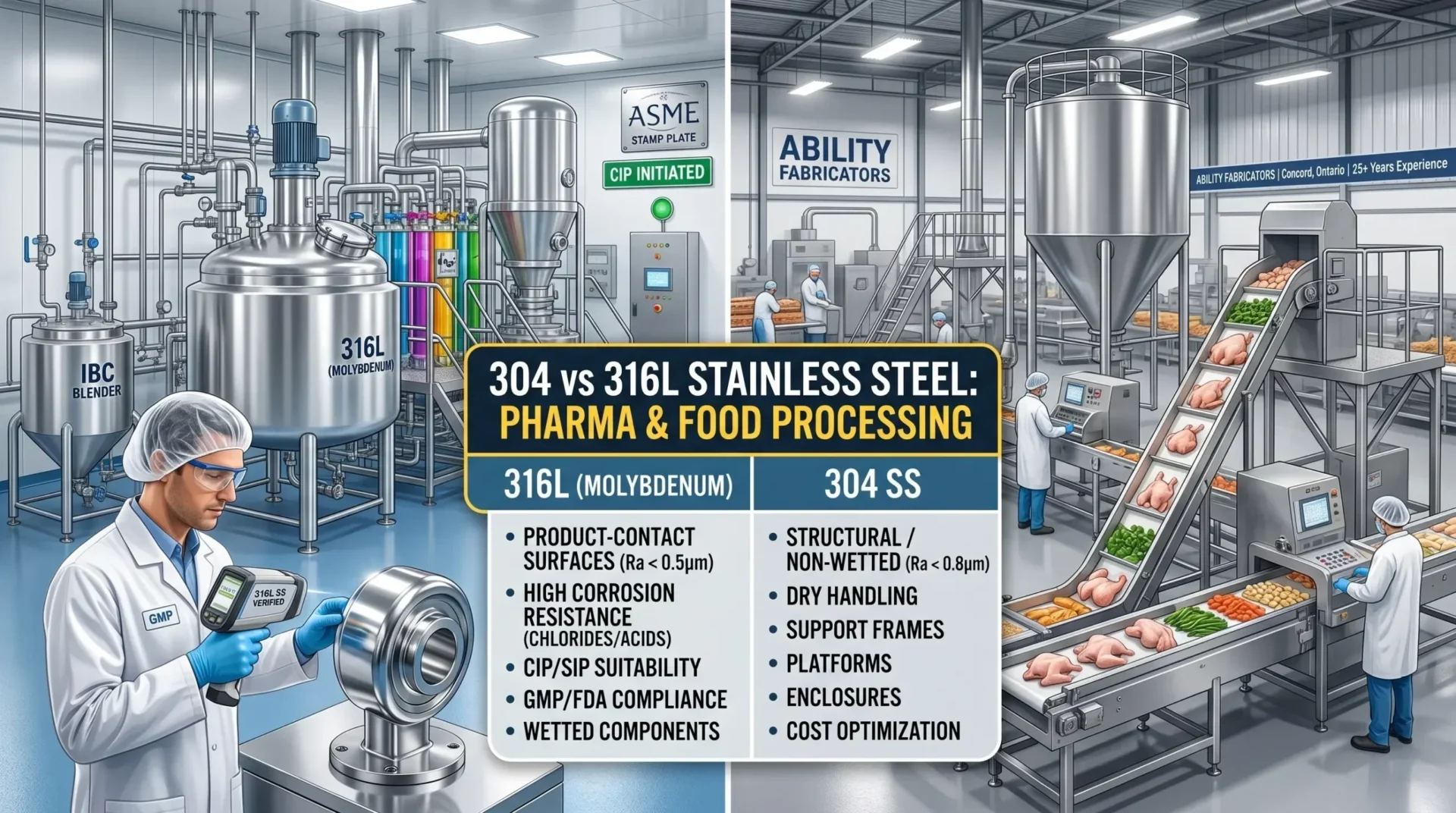
| 316 / 316L Stainless Steel | Superior (Resists pitting from chlorides, acidic foods, and aggressive CIP chemicals) | Very High | Premium | Direct product-contact parts, filling valves, dosing pumps, and sterile pharmaceutical tooling. |
Strict Regulatory Compliance & Washdown Longevity
At ZSCNC, we manufacture stainless steel components that satisfy stringent FDA, USDA, and European regulatory standards for food and drug processing. Our advanced surface finishing techniques ensure low roughness ($R_a$) values to eliminate microscopic traps for bacterial contamination.
Based on our extensive project deployment in sterile environments, choosing the correct grade and surface finish prevents localized stress corrosion cracking and ensures hassle-free facility audits during rigorous cleaning protocols.
Consult an Engineer on Stainless Steel Parts SelectionTitanium Alloys: Special Materials for Extreme Conditions and High-Value Product Lines
Titanium alloys combine an exceptional strength-to-weight ratio, high fatigue resistance, and outstanding chemical compatibility. For specialized packaging machinery, they offer a reliable solution when traditional metals fail under severe operational stresses.
These materials are typically reserved for critical components exposed to aggressive cleaning agents, high-temperature sanitization, and strict sanitary requirements in high-end pharmaceutical, fine chemical, and specialty food packaging lines.
While titanium provides unrivaled long-term durability, the upfront raw material costs are higher, and its inherent toughness demands precise CNC machining controls, strict tolerance management, and experienced engineering oversight.
We recommend a selective design strategy: deploy titanium alloys exclusively at high-wear, highly corrosive nodes where extended operational lifespan and zero-contamination risks fully justify the investment over standard structural alternatives; our titanium parts catalog is engineered precisely for these demanding applications.
Application Suitability & Risk Assessment Checklist
- Continuous exposure to aggressive chemical sanitizers or CIP/SIP solutions
- Critical weight reduction needed for high-speed, low-inertia moving parts
- Superior pitting and stress corrosion resistance compared to 316L stainless steel
- High-value packaging applications requiring strict zero-contamination compliance
- Complex geometries where tight tolerances must remain stable under thermal load
- Total lifecycle optimization where reduced downtime offsets higher upfront material costs
POM (Acetal): The Cost-Effective Choice for Packaging Conveyors & Guides
POM offers excellent self-lubrication, high dimensional stability, and outstanding machinability, making it a highly cost-effective metal alternative for high-friction packaging components. It is engineered to optimize smooth material handling while keeping production costs low.
High Rigidity & Low Friction
With a low coefficient of friction and high wear resistance, POM provides smooth sliding contact, reduces machinery noise, and minimizes the need for external lubricants.
Typical Packaging Applications
Perfect for non-contact moving parts including conveyor chain wear strips, guide rails, star wheels, sorting gates, and low-load bushings where noise reduction is critical.
Rapid Prototyping & Production
ZSCNC leverages advanced CNC machining to deliver high-precision POM components quickly. Explore our POM parts to see how we can support your packaging line retrofits.
Chemical & Thermal Limitations
- POM is not suitable for high-temperature steam sterilization or autoclaving processes.
- It exhibits poor resistance to strong acids, oxidizing agents, and aggressive alkaline washdown chemicals.
- Always verify chemical compatibility with your specific CIP (Clean-in-Place) sanitizers before selecting POM.
PEEK: High-Performance Engineering Plastic for High-Temperature & Strict Hygiene Applications
Polyether ether ketone (PEEK) is an advanced engineering polymer designed to retain its mechanical strength and dimensional stability in extreme environments. It is ideal for demanding packaging equipment components subjected to continuous high-temperature washdowns, harsh chemical agents, and repeated sterilization cycles, particularly where metal-to-metal friction or particulate risks must be eliminated.
| Material Selection | Temperature Resistance | Chemical Compatibility (CIP) | SIP/Sterilization Tolerance | Machinability & Lead Time | Total Lifecycle Cost |
|---|---|---|---|---|---|
| PEEK | High (Up to 250°C / 482°F) | Excellent (Broad pH range) | Excellent (Repeated steam/autoclave) | Challenging (Requires stress-relieving) | Premium investment |
| POM (Acetal) | Moderate (Up to 120°C / 248°F) | Moderate (Sensitive to strong acids/oxidizers) | Limited (Not for continuous steam) | Excellent (High-speed machining) | Economical / Low cost |
| Stainless Steel | Extreme (Up to 800°C+ / 1472°F) | Excellent (Grade dependent like 316L) | Excellent (Unlimited cycles) | Moderate to hard (Higher tool wear) | Moderate to High (Heavy weight) |
Core Packaging Industry Applications
- Aseptic Pharmaceutical Lines: Direct contact parts, filling needles, and sorting discs requiring strict FDA or EU compliance without risk of metallic contamination.
- High-Temperature Washdown Zones: Components exposed to aggressive CIP/SIP cycles, high-pressure steam, and concentrated alkaline or acidic sanitizers.
- Friction & Wear Components: High-speed scraper blades, bushings, and filling valve seals where traditional lubrication is strictly prohibited.
- Precision Moving Parts: Lightweight structural elements needing high fatigue strength to minimize inertia and optimize power efficiency.
While PEEK offers unmatched mechanical performance, its high raw material cost and narrow machining window require specialized engineering expertise. At ZSCNC, we implement precise stress-relieving procedures and custom tooling geometries to ensure tight tolerances, preventing post-machining warping and maximizing the service life of your high-value packaging components. Learn more about our CNC machining parts solutions tailored for high-performance polymers.
Material Selection Matrix for Common Packaging Scenarios
Accelerate your design cycle by converting abstract material properties into concrete engineering choices. This matrix outlines primary and alternative materials based on real-world packaging machinery projects, helping you optimize performance, maintain regulatory compliance, and control production costs. Explore our CNC machining parts engineered for packaging line reliability.
| Packaging Application Scenario | Primary Material | Alternative Material | Engineering Selection Rationale |
|---|---|---|---|
| Food Filling Valves (Direct product contact, frequent CIP/SIP washdowns) | 316L Stainless Steel | PEEK | 316L provides exceptional sanitation compliance and acid/alkali resistance. Our stainless steel parts maintain integrity in continuous washdowns. PEEK is chosen when metal-to-metal friction or particulate risk must be entirely avoided. |
| Conveyor Guide Rails & Support Components (Low load, minimal chemical exposure) | POM (Polyoxymethylene) | Aluminum Alloy | POM offers excellent self-lubrication, low friction, and cost-effective CNC machining for noise reduction. Aluminum serves as a rigid structural alternative. |
| Sealing Mechanism Moving Parts (Mid-to-high speed, moderate temperature exposure) | Aluminum Alloy (Anodized) | POM | Anodized aluminum delivers the lightweight structure required to reduce inertia in high-speed motion, while POM minimizes wear on mating components. |
| Pharma Sterile Packaging Fixtures (High hygiene standards, high-temp steam sterilization) | PEEK | Titanium Alloy | PEEK maintains superior dimensional stability under continuous autoclave cycles. Titanium is utilized for premium titanium parts facing aggressive sanitizers. |
Looking for a Customized Material Matrix for Your Machinery?
The recommendations above serve as a foundational guide, but unique chemical concentrations, mechanical loads, and clean-in-place configurations require tailored evaluation. The ZSCNC engineering team leverages extensive production data to help you select the exact material grades that balance compliance, part longevity, and budget constraints.
Comprehensive Material Comparison: Performance vs. Cost vs. Machinability
Balancing engineering requirements with project budgets is critical for packaging machinery optimization. Review our technical trade-off matrix to find the optimal sweet spot between operational lifecycles, material costs, and processing complexity. For deeper process insights, consult our CNC machining guide.
| Material Type | Mechanical & Hygienic Performance | Cost Level | Machinability & Lead Time |
|---|---|---|---|
| Aluminum Alloy | Moderate (Ideal for non-contact structural frames) | $ | |
| Stainless Steel | High (Standard for sanitary food/pharma contact) | $$$ | |
| POM (Acetal) | Good (Low friction, perfect for wear strips & guides) | $$ | |
| PEEK | Excellent (Extreme chemical resistance & high-temp CIP/SIP) | $$$$$ | |
| Titanium Alloy | Exceptional (High strength-to-weight, specialized lines) | $$$$$$ | |
Decision Guidelines: For general sanitation and heavy washdowns, lean toward stainless steel. When lightweight speed or cost is paramount, aluminum or POM are excellent non-contact choices. For demanding CIP/SIP thermal cycles, upgrade to PEEK to avoid premature component failure.
Common Material Selection Mistakes: High Upfront Savings, Higher Lifecycle Costs
In the packaging industry, material failures lead to unscheduled downtime, batch contamination, and compliance audits. Recognizing these frequent engineering pitfalls early protects your production line efficiency.
Mistake 1: Prioritizing Initial Material Costs
Selecting a material based purely on the raw stock price tag often leads to premature component wear, frequent maintenance shutdowns, and unexpected replacement expenditures.
Mistake 2: Blindly Overusing Stainless Steel
Using heavy stainless steel parts for every component causes over-engineering, increases machinery inertia, and drives up costs where lightweight aluminum or durable POM would perform better.
Mistake 3: Ignoring Washdown Chemistry
Neglecting how materials react to aggressive CIP/SIP chemical agents and high sterilization temperatures results in rapid stress corrosion cracking, pitting, and fluid leakage.
Mistake 4: Overlooking CNC Machinability
Specifying exotic alloys or ultra-hard polymers without evaluating manufacturing feasibility leads to extended lead times, excessive tool wear, and high prototype iteration costs.
Early Technical Reviews Eliminate Up to 70% of Downstream Redesign Costs
When onboarding mechanical optimization projects, our teams frequently find that premature component failure stems from early-stage material oversight rather than poor manufacturing. Factoring in chemical exposure, structural load, and hygiene standards from day one safeguards your operational integrity.
Conducting a thorough engineering review before finalizing your design ensures your selected materials align perfectly with regulatory compliance, target operating life, and budget constraints.
Not Sure Which Material to Choose? Send Your Application Requirements to Our Engineers
Simply provide your key operating conditions—such as food/pharma contact requirements, operating temperatures, and cleaning protocols. The ZSCNC engineering team will analyze your data and deliver a tailored material recommendation within 48 hours to help optimize your packaging machinery's performance and cost. If you prefer direct coordination, visit our contact page to reach the ZSCNC engineering team.
How to Submit Your Parameters
To help our engineers isolate the best candidate materials, please specify whether the part has direct product contact, how frequently it undergoes CIP/SIP sanitization, the chemical compounds used in washdowns, and any weight restrictions for high-speed moving assemblies.
Why Partner with ZSCNC's Engineering Team?
- Cross-Material Expertise: Unbiased evaluation across Aluminum, Stainless Steel, Titanium, POM, and PEEK based on true operational requirements.
- Application-Driven Solutions: Balanced recommendations that weigh regulatory compliance (FDA/EU) against manufacturing costs.
- CNC Feasibility Insight: Direct alignment between material selection and machining efficiency to prevent delivery delays.
- Risk Mitigation: Early stage material review helps eliminate up to 70% of downstream component failures and unexpected washdown corrosion.
Submission Confirmation: Our engineering team will review your application parameters and respond with an actionable technical recommendation within 48 business hours.
Let Material Selection Drive Your Packaging Success, Not Equipment Downtime
Choosing the right balance between aluminum, stainless steel, titanium, POM, and PEEK directly dictates your packaging equipment's reliability, compliance, and lifecycle costs. When balancing complex machining geometries with strict sanitary mandates, integrating this guide with our broader engineering network helps mitigate compliance risks and preventable component failures.
CNC Machining Guides
Review critical manufacturing tolerances, surface finish specifications, and machinability ratings for high-performance packaging polymers and alloys in our dedicated CNC machining guide.
Explore CNC GuidesApplication FAQs
Find immediate engineering answers regarding CIP/SIP chemical compatibility, galvanic corrosion prevention, and FDA-compliant material sourcing with our comprehensive engineering FAQ resources.
Packaging Industry Insights
Access real-world case studies detailing how optimizing automated filling lines and cross-contamination barriers lowers total cost of ownership.
Bookmark this material selection matrix as a practical checklist for upcoming design reviews and vendor audits. As your long-term engineering and manufacturing partner, ZSCNC helps you reduce production risks, control project budgets, and enhance machine competitiveness.