
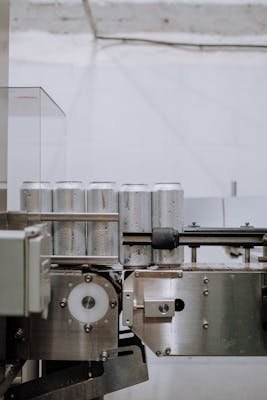
Packaging equipment relies on hundreds of precision components working together to achieve high-speed, reliable operation. Understanding which parts benefit most from CNC machining can help you make smarter sourcing decisions, reduce downtime, and improve overall equipment performance. At QuikCNC, we have machined thousands of packaging machine components across food, pharmaceutical, and cosmetic applications. Here are five common parts that consistently benefit from precision CNC machining.
🔩 1. Filling Nozzles
Filling nozzles are critical components in liquid and powder packaging machines. They must maintain precise internal diameters, smooth surface finishes, and exact thread specifications to ensure consistent flow rates and dripless operation. CNC machining delivers the tight tolerances required — typically ±0.01mm — and allows for complex internal geometries that would be impossible with conventional methods.
Materials: Stainless steel 304/316 (food-grade), aluminum, PTFE-coated variants
Key specs: Ra ≤ 0.8μm surface finish for food contact, internal bore tolerance ±0.02mm
Why CNC: Every nozzle must be identical for consistent fill weights. CNC machining ensures repeatability across production runs, whether you need 10 or 10,000 pieces.
⚙️ 2. Sealing Jaws
Heat sealing jaws are used in form-fill-seal (FFS) machines, pouch packaging, and blister packaging equipment. These parts require precise flatness, uniform heat distribution, and exact alignment. CNC machining with proper surface finishing ensures that sealing surfaces are perfectly parallel and achieve consistent seal quality across every cycle.
Materials: Aluminum 6061, brass, stainless steel with PTFE or ceramic coating
Key specs: Flatness within 0.05mm, surface finish Ra 0.4-0.8μm
Why CNC: Uneven sealing jaws cause leakage and product waste. CNC machines hold the tight tolerances needed for consistent seals at high speeds.
📦 3. Conveyor Guides and Rails
Conveyor systems in packaging lines use guide rails, wear strips, and transfer plates to move products smoothly between stations. These parts must be dimensionally accurate, wear-resistant, and often require complex profiles with mounting holes, slots, and chamfers.
Materials: UHMW-PE, Nylon, POM (acetal), aluminum, stainless steel
Key specs: Straightness within 0.1mm per meter, smooth edges to prevent product damage
Why CNC: CNC machining produces consistent profiles across long lengths (up to 2 meters) and allows for integrated mounting features in a single setup.
🔧 4. Timing Screws and Star Wheels
Timing screws and star wheels control product flow and spacing in packaging machines. These parts have complex helical or contoured profiles that must be precisely matched to the product shape and size. CNC machining with 4-axis or 5-axis capabilities can produce these intricate geometries with exceptional accuracy.
Materials: Nylon, POM (acetal), aluminum, stainless steel
Key specs: Profile tolerance ±0.05mm, surface finish Ra 1.6μm for smooth product handling
Why CNC: The complex 3D profiles of timing screws require multi-axis CNC machining. No other manufacturing method can achieve the required precision at a reasonable cost.
🛡️ 5. Valve Bodies and Manifolds
Pneumatic and hydraulic valve bodies control the actuation of various packaging machine functions — clamping, cutting, lifting, and dispensing. These parts require precise internal passages, threaded ports, and sealing surfaces. CNC machining from solid bar stock or billet provides superior strength and leak-free performance.
Materials: Aluminum 6061/7075, stainless steel 304/316, brass
Key specs: Port thread tolerance Class 2A/2B, internal passage surface finish Ra 3.2μm
Why CNC: Leaks in valve bodies can cause machine downtime and product contamination. CNC machining ensures leak-tight components with consistent thread quality across every part.
🏭 Why Choose QuikCNC for Your Packaging Machine Parts?
At QuikCNC, we understand the unique demands of the packaging industry. Our facility features over 20 advanced CNC machines including 3-axis, 4-axis, and 5-axis machining centers, capable of handling parts from prototype quantities to high-volume production runs of 100,000+ pieces per month.
- ISO-compliant quality control with CMM inspection
- Material certifications for food-grade and pharmaceutical applications
- Fast turnaround — quotes within 24 hours, production within 3-7 business days
- No minimum order quantity — order just 1 piece for testing
- Free DFM (Design for Manufacturing) feedback
❓ FAQs About CNC Machining for Packaging Machine Parts
Q: Do you provide material certifications?
A: Yes, we provide mill test reports and material certifications for all metals and engineering plastics used in your parts.
Q: What tolerances can you hold?
A: We can achieve tolerances as tight as ±0.005mm for critical features, with standard tolerances of ±0.05mm for most packaging machine parts.
Q: Can you machine parts from drawings only?
A: Yes, we accept PDF drawings with dimensions, as well as 3D CAD files in STEP, IGES, or DWG format.
Q: How do you ensure part quality?
A: Every part undergoes dimensional inspection using CMM, micrometers, and gages. We provide inspection reports upon request.
🔍 How CNC Machining Improves Packaging Machine Performance
The precision offered by CNC machining directly translates to better packaging machine performance. When components are machined to exact specifications, machines run faster, produce less waste, and require fewer adjustments. Heres how precision CNC machining impacts key performance metrics:
Reduced Changeover Time: When parts are dimensionally consistent, changeover between product runs becomes faster. Operators can swap filling nozzles, change parts, and adjust guides without trial-and-error fitting. This can reduce changeover time by 30-50% compared to using parts with inconsistent dimensions.
Lower Rejection Rates: Precision-machined parts ensure consistent fill weights, accurate seal placement, and proper product handling. This directly reduces the number of rejected packages, saving material costs and improving overall equipment effectiveness (OEE).
Extended Machine Life: Properly machined components distribute loads evenly, reduce vibration, and minimize wear on mating parts. This extends the service life of both the replacement part and the surrounding components.
🏗️ Materials Selection Guide for Packaging Machine Parts
Selecting the right material for each packaging machine component is critical for performance and longevity. Here is our quick reference guide based on common packaging applications:
For Food Contact Parts: Stainless steel 316 is the preferred choice for parts that contact food products. It offers excellent corrosion resistance, is easy to clean, and meets FDA requirements. When weight is a concern, food-grade aluminum with proper surface treatment is a viable alternative.
For High-Wear Components: Tool steel or hardened stainless steel is recommended for parts that experience sliding contact or high cycle counts. For plastic components in wear applications, PEEK offers exceptional wear resistance and dimensional stability.
For Chemical Exposure: PTFE and PEEK both offer excellent chemical resistance. PTFE is ideal for non-stick applications while PEEK provides superior mechanical strength for structural chemical-handling components.
For Lightweight Applications: Aluminum 6061-T6 offers an excellent strength-to-weight ratio for parts that need to be moved or adjusted frequently. It is also more cost-effective than stainless steel for non-food-contact applications.
For Low-Friction Applications: POM (acetal), Nylon, and PTFE are all excellent choices for guide rails, wear strips, and bearing surfaces. Each offers different tradeoffs between friction coefficient, wear resistance, and cost.
📐 Tolerance Guide for Packaging Machine Parts
Different packaging machine functions require different tolerance levels. Heres a practical guide:
- ±0.1mm: Suitable for non-critical structural parts, brackets, guards, and covers
- ±0.05mm: Standard for most functional components including conveyor guides, mounting plates, and general machine parts
- ±0.025mm: Required for precision components like sealing jaws, filling nozzles, and mating surfaces
- ±0.01mm: Critical for timing screws, star wheels, and components that affect product registration
- ±0.005mm: Ultra-precision for valve components, metering parts, and high-speed applications
Specifying unnecessarily tight tolerances increases cost without providing functional benefit. Our engineers can help you identify which dimensions are critical and which can be relaxed to optimize cost.
🔄 Replacement Parts vs. Custom Components
QuikCNC supports both OEM replacement parts and custom-designed components. For replacement parts, we can reverse-engineer existing components from samples or drawings. Our CMM measurement capabilities allow us to capture critical dimensions from worn or damaged parts and reproduce them with improved accuracy.
For custom components, our engineering team provides DFM feedback to optimize your design for CNC machining. We can suggest material alternatives, modified geometries, and surface finish options that improve performance or reduce cost.
💰 Cost Optimization Strategies for CNC Machined Parts
Getting the best value from your CNC machined packaging machine parts requires strategic thinking about design, material selection, and quantity. Here are proven strategies we recommend to our clients:
- Design with standard materials: Using common grades like 6061 aluminum, 304 stainless steel, or POM acetal reduces material costs and lead times compared to specialty alloys or exotic plastics.
- Combine multiple parts: Where possible, combine multiple components into a single machined part to reduce assembly costs and improve structural integrity.
- Order in batches: While we accept single-piece orders, ordering in quantities of 10-100 pieces significantly reduces the per-unit cost by spreading setup and programming time across multiple parts.
- Relax non-critical tolerances: Identify which dimensions truly need tight tolerances and which can be standard. This simple step can reduce machining time by 20-30%.
- Consider surface finish tradeoffs: As-machined finishes are free. Every additional finishing step adds cost — only specify the finish you actually need.
📞 Ready to Improve Your Packaging Line?
Whether you need replacement parts for existing equipment or custom components for a new machine design, QuikCNC delivers precision CNC machined parts you can rely on. Contact us today for a free quote within 24 hours.